Azur Indian Music Project

My photo
San Jose, San Jose, Costa Rica
Welcome to our music for development space where we will try to keep our friends updated on Azur Indian's latests. We also hope to engage actively with other musicians and anyone who is interested in development issues in general to hopefully reach higher grounds. So please, post your comments and share your thoughts with us! Azur Indian(アズール・インディアン)のブログへようこそ!このページでは私たちの活動をご紹介していくほか、音楽に興味がある方、国際協力・開発に興味がある方との交流の場を作っていければと考えています。みなさんの思いやコメントをこの場でぜひ共有してください!

Monday, 31 January 2011

New composition for the school project 18 November 2010

I worked on this composition as a part of my class project, "Costa Rica Landslide Awarenss Project" and it was the first time make a serious composition after almost 20 years (if I remember correctly)! .

To explain a bit about the background why the idea of composition popped up, there was a severe landslide occured in Escazu, Costa Rica (near its capital San Jose) in early November and that killed 28 people, 4,900 people were displaced.

The class decided to cover this natural disaster with the means of media, since we major in Media and Conflict Studies. We already have quite a few people in our class who used to work as a journalists, and they all showed their professionalism which really impressed me. That made me think that I also would like to contribute this project with my profession.

This is the consequesnce of our class project on the "Costa Rica Landslide Awareness Project", please have a look! You can find various interesting perspectives through reading them.

Regarding the music composition, the main aim I put was to connect our class project with the local Costa Rican people.

First of all, I needed to feel this tragedy with my heart not my head. Ingmar and Tatiana's pictures helped me to know what really happened to people in Ezucas, and feel how people are suffering from it.  

Then, I extracted some of the essence of the world music that I asked the classmates to send me in advance and synthesise these elements to the basic melody that came from my impression when looking at the pictures. 

Therefore, you may find some parts of the melody sounds like ethnical music with "the 4th and 7th lacking scale" from Icelandic music, "glissando" from French traditionl music, and "tremolo" from Pakistani traditional music. It was also advantage for the cello to play "glissando" and "tremolo" because the cello as an instrument is good at describing these technics. This composition was composed for cello and piano duet, needless to say.


Let me also note technical aspects.
The composition was set as h-moll (B minor). Firstly, 4 bars of motive (A) that came from the impression from the pictures was made, and it was expanded to another 4 bars (A'). Then, in order to transit the tune to D-dur (D major), 7th code was implemented (in this case, it was A7).  2 motives of 4 bars in D-dur were followed (B and B'), and it transitted back to the initial tune: h-moll (A'').

The second part was made for piano, and the cello which played main melody for the first part now becomes the accompaniment for the piano's main melody. Starting with h-moll, it transitted to g-moll. After all, it came back to initial h-moll as the third part of the composition, and had 2 motives of 4 bars (A''' and A''''), it ended with the picardy terminate in order to show the hope at the end.

The flow of the tune was
h-moll (B minor) --> D-dur (D major) -->h-moll (B minor) -->g-moll (G minor) --> h-moll (B minor) --> H-dur (B major)

The flow of the code was
Bm-->A-->Fsharpm7-->Bm-->Bm-->A-->Fsharpm7-->Bm
A-->D-->A-->A-->D-->D-->A-->Fsharpm7-->Bm
Bm-->A-->Fsharpm7-->Bm-->Bm-->A-->Fsharpm7-->Bm
Bm-->Em-->Fsharp-->Bm-->Fsharp7-->Gm-->Cm-->Dm-->Gm-->Dm-->Gm-->Dm
Gm-->Gm-->Cm-->Gm-->Gm-->Cm-->D7-->Gm-->Cm-->Gm-->Cm-->D-->D7-->Gm-->
Gm-->Gm-->Cm-->Gm-->Gm-->Cm-->D7-->Gm-->Cm-->Gm-->Bflat-->Emdim7
D-->Eflat-->F-->Fsharp7
Bm-->A-->Fm7-->Bm-->Bm-->A-->Fm7-->Bm-->B


30th Anniversary for University for Peace: 10th December 2010

We were given a chance to play for the 30th Anniversary for University for Peace. This ceremony was particularly dedicated to the school founder: Rodrigo Carazo Odio, who was a former Costa Rican president from 1978 to 1982. He passed away in 2009. (cf: http://en.wikipedia.org/wiki/Rodrigo_Carazo_Odio)


We were asked to play Latin American music, so what we opted were:
-Libertabgo (Astor Piazzola) 
-Luna Liberiana (Jesus Bomilla) 

As for Libertango, needless to say, Astor Piazzola is famous for Tango composer from Argentine.

Luna Liberiana was composed by a Costa Rican composer called "Jesus Bomilla", and what a coincidence, 2010 was the 75th anniversary after it was composed.

Someone at the ceremony told me that "Luna Liberiana" is in the heart of Costa Rican people with the memories of summer time when they were young.

It was warm moment that guests for the ceremony joined us to sing when we started playing it, seemed like people were remembering their past times.

Entry:Midori

Azur Indian's new project for an duo concert: 1st and 3rd December 2010

Midori accompanied four cello students, one violin student and one sax student on her piano on the 1st and 3rd December.

This was the second occasion to implement the new project: supporting music students for their performance.

This concert was performed by outstanding students from Casa de la cultura in Ciudad Colon, and it functions as one of few occasions for students to perform their music ability in public. I was inspired by the students, everyone played very well with the intense concentration, Good job, guys!

If you are looking for more hands for your performance, or need an accompaniment for your performance, please contact us at: azur.indian@gmail.com

We support you with
-Cello
-Violin
-Piano
-Vocal


Azur Indian's new project in an orchestra concert: 28th November 2010

Supporting music students for their performance at the stage has just been installed as one of Azur Indian's projects, and the concert on the 28th November was the first occasion to put this into practice.

This new project aims supporting youth's performance when they need more hands for their play at the stage.

We provide violin, cello, vocal and piano for this project. It can be used for the help for an orchestra when you simply need more people in your group, piano accompaniment for chamber music when you cannot find a piano accompanist, or vocal support for choir when you need more vocal volume.

The concert on the 28th November was organised by El Centro Cantonal de Cultura de Mora (Mora Cantonal Centre of Culture and there were two youth orchestras playing in this concert. One was Youth Orchestra of Guayabo de Mora, and the other one was Youth Orchestra of Mora Cantonal Centre of Culture.


(Today's programme)

Midori supported the youth orchestra of Mora Cantonal Centre of Culture with the violin as Azur Indian's new project. It was conducted by Sergio Nunes, the directer of Casa de la Cultura of Ciudad Colon, and we played:

1. Theme from the New World (A. Dvorak)
2. Let it be (J. Lennon)
3. Sonidos del Selencio (P. Simon)
4. Popurri brasileno (A. Barraso)


Entry:Midori

Monday, 8 November 2010

Poster

Here's the posters for the last event:
Innovations for International Development "Linking good ideas with good intentions"


We took the template from the same design used for our christmas presentation in 2008..
This was done with the help of a designer,
Thanks Omar!

Entry: Antarqui

Innovations for International Development Conference (entry continued)

This conference was of great success up to my consideration, taking into account the resources and time constraints due to a sudden change of venue brought up by  poor weather conditions and landslides that affected the surrounding areas of the UPEACE campus. Nevertheless the conference moved on smoothly in the Humboldt University in Pavas. The conference with different programs and thematic presentations allowed for networking and for the audience to participate in very interesting topics such as the ones mentioned in the previous post.

There is something that will stick with me from the initial presentations and that is the DIMENSIONS for international development projects by Renata Villers:
1.     Innovation in delivery and management of products and services
2.     Multi-Sectoral (presented also by Prof. Jan Pronk as the requirement of institutions for technical advances)
3.     Strategic management practices
4.     Scalable designs
5.     Measurement of results
6.     Financially sustainability design
7.     Policy dimensions

I think this will help very much in the analysis of our Music for Development Project, because it brings a clear and logical framework to work with.
Readers: Is there anything missing in these dimensions??

I wanted also to take this chance to post here the outline of the learnings from the Azur Indian Project presented in Japan, in the hopes of getting some feedback out there on how to move it forward.

Azur Indian Music Project
~Getting to know the world through Music~
6 November 2010
Azur Indian Music Project
Midori Kamada
Antarqui Romero
Overview:
To think about raising awareness on development issues through music, brings the question on how to link these two worlds together. Until today, for a cello and piano duet, the answer to that question varies according to the circumstances and audience to whom the presentation is intended for.  Consequently, the initial segment within which we focused our energy was primary schools and junior high schools, since these facilitated our efforts of association, definition of the performance site, and most importantly, the opportunity to touch these minds in development, to realize our objectives of raising understanding on ways to alleviate poverty and how to help build sustainable livelihoods, according to our experience in the field.

This project was validated as an NGO by the International Division of the City Office of Niigata, Japan. Since 2008 we have been active with this project and have managed to make many presentations that vary from among other topics:
Experience as a volunteer and how to become a part of this form of aid.
Developing countries and the differences between Japan on poverty issues and developing opportunities.
Music appreciation and early stimulus through sound.

The objectives:
Presented to schools initially and then to other organizations ranged from the following:
1. To be familiar with international music and instruments through live music appreciation.
2. To acknowledge the relationship between Japan and other countries such as Honduras and Zimbabwe through lectures and music instruments from those regions.
3. To be familiar with the cultures and the customs of countries/regions which are relatively unheard of in Japan such as those from Honduras, Zimbabwe, and in general Central America and Southern Africa.
4. To recognize their own Japanese traditional music through music appreciation.
5. To familiarize themselves with foreign languages such as English, Spanish and Shona.
7. To expand their knowledge on International Relationships in a rapidly changing multi-cultural society.

To achieve this, the topics and music presented in our lectures were set together with the school’s representatives according to their teaching agenda, and to develop a relationship with the students that would help in the communication process we attempted to build a set of presentations for that audience.

The balance between music and the lectures was defined in accordance to the audience’s age and interest, the depth and approach, grew from a familiar music repertoire, to international music that helped introduce the topics in the lecture.
Learnings:
This project brought a set of highs and lows in terms of seasonality.
Making our presentations for schools required adaptation to their yearly programs which sometimes was filled beforehand and had no space for events such as our project. This led to searching for more schools and other institutions that would keep us afloat regarding our expenses, which meant being more flexible in terms of these organizations’ requests, sometimes focusing more on music than our lectures.

Although we charged to cover our expenses for each presentation, if there had been financial support to charge less to these institutions, the control over the content and the amount of acceptance or repetitions on presentations would have been more. Therefore, something to look into for our project is alternative funding

Another important thing to consider regarding the initial question in this paper on how to link the world of music and development, now that Azur Indian is in Costa Rica, is the approach of the lectures.
In Japan we presented information about developing countries, but now that we are in a developing economy, we see music itself as a form of development. Music provides the tools for education to flourish, and a way to encourage a career path through music as an option. This is what we are now looking into in order to move our project forward now in Costa Rica

We would appreciate it if you can provide some feedback on your experience or any advice regarding our learnings and future goals.


Azur Indian

Entry: Antarqui

Sunday, 7 November 2010

Club Union San Jose: 4th November 2010

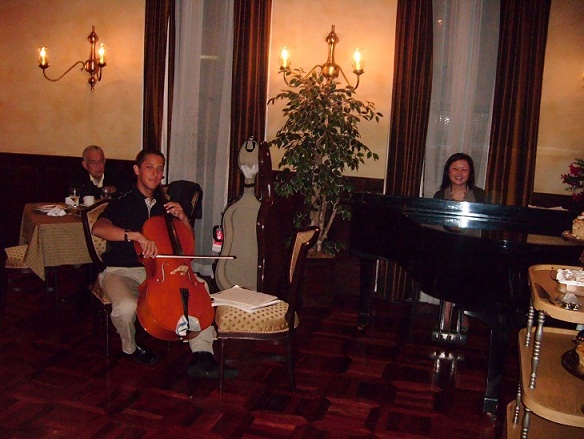
We practiced at "Club Union"(http://www.clubunion.com/) in San Jose today. This place was established in 1923, since then it has been utilized by important figures of Costa Rica such as politicians, entrepreneurs and so forth. I can imagine how those people talked in this place, having cigar and whisky, sitting on a comfortable sofa in front of a fireplace...(ummm maybe not a fireplace because Costa Rica is too hot to have one!)  


This construction has several rooms such as a conference room, a billiard room, a bar.... where we practiced was in restaurant. It was rich in ornament with beautiful a drawing (5 women representing central America) and chandelier.


The piano they have here was Yamaha, piano de cora (fluegel klavier). It was over all in good condition! I was too excited to play this piano in this spacious restaurant. There was no one in the restaurant when we arrived there, so started practicing immediately. We were a little excited since it was for the first practice after half a year.

After a while, we also had dinner there. I ordered a glass of red wine....it tasted just super, had rich flavour in it...fruity but heavy. I loved it!! Can you believe it was just a glass of wine, not like selected bottle?


For the main (though it was salad) I ordered Grey Palmito and Salmon Salad. I tasted White Palmito (heart of palm) a week before in Puntarenas, and really liked it because it was just like Bamboo which is my favourite. But this Grey Palmito (the long one in the picture) is very special in terms of its taste and the place you can have......the taste wise, I could feel the taste of palm, while the white one has slightly less taste of it. And the place wise, you cannot find grey one anywhere else in Costa Rica but only in this Club Union.


This one is white palmito, for example. A very kind servant brought it to us to compare with the grey one. The red fruit is actually from the same palm tree which bears palmito! You would boil it, and peel the skin and then eat it. This part tasted just like Chestnuts! The servant told us that Costa Rican people loves this fruit!


I was completely satisfied and inspired by the cuisine! Everything has own taste, even the butter for bread. I could feel the milk in it!

Well, today's entry turns to be a "restaurant report..." :))

After the meal, we played for customers who were having dinner then.

It things allow, we hope to practice here from time to time.

Entry: Midori